The Impact of IP Blacklisting on Email Deliverability: A 2026 Strategic Guide
Email Infrastructure & Marketing ROI
Quick Navigation
Why Your Emails Are Bouncing?
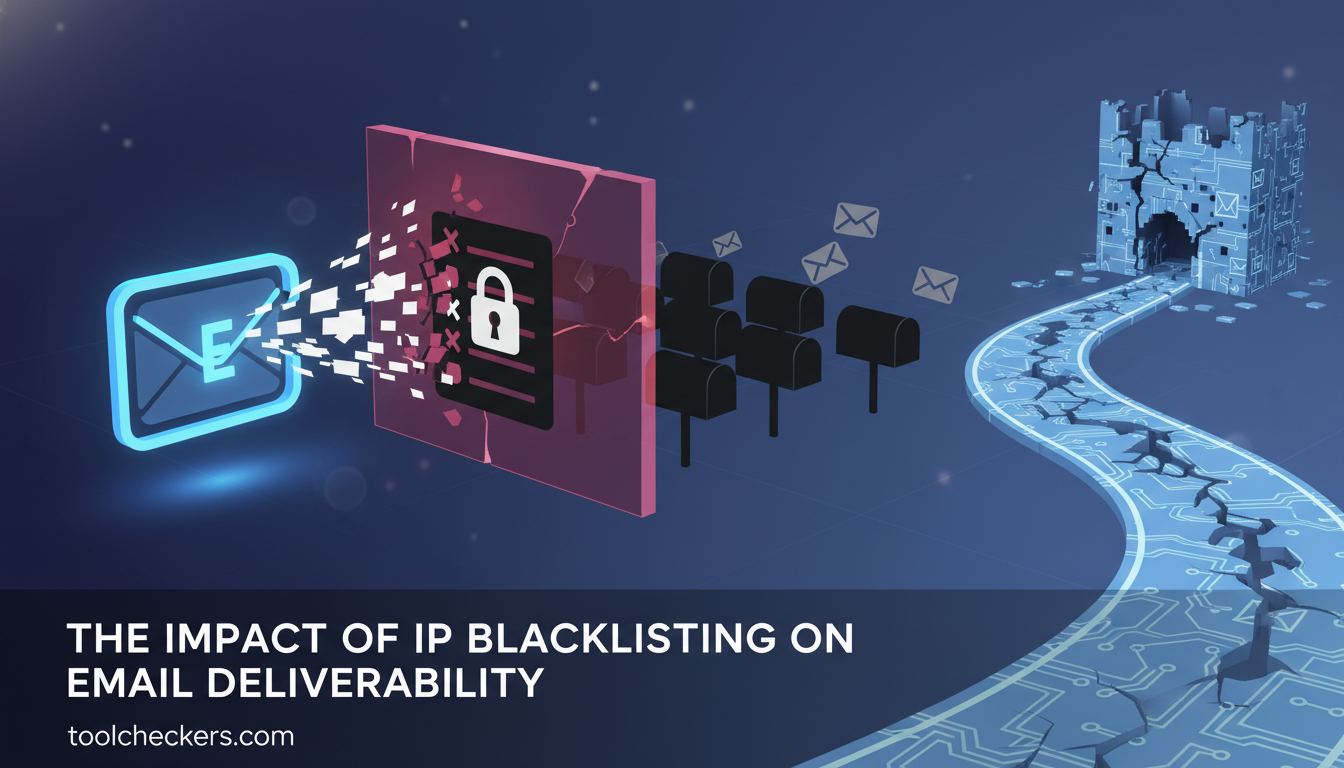
Quick Answer: High email bounce rates are primarily triggered when a receiving mail server rejects a message due to a poor mail server reputation or an active IP blacklist status. Resolving these email deliverability issues requires identifying whether the block is at the IP or domain level and verifying authentication protocols like SPF and DKIM.
In 2026, the landscape of email communication has shifted from simple spam filtering to sophisticated AI-driven behavioral analysis. When we talk about "bouncing," we aren't just discussing a wrong email address. We are discussing the gatekeeper—the receiving ISP (Internet Service Provider)—deciding that your server is "untrustworthy."
Recent data from 2025 indicates that even a 0.5% presence on major RBLs (Real-time Blackhole Lists) can decrease your overall inbox placement by up to 22%. It's no longer about staying off all lists; it's about staying off the critical ones that Google and Microsoft prioritize.
The primary driver behind these rejections is the bounce rate. If your server repeatedly attempts to send to "honey pots" or dead addresses, ISPs flag your IP as a source of "low-intent noise." This triggers a cascade of email deliverability issues that can take weeks to remediate without the right tools.
What is the Role of IP Reputation?
Quick Answer: IP reputation is a quantitative score assigned by ISPs to gauge the trustworthiness of a sending IP address based on historical sending patterns and recipient engagement. A high reputation ensures your messages bypass the spam folder and reach the primary inbox.
Think of your IP reputation as a credit score for the digital world. Every time you send an email, the receiving server checks your "financial history" of sending. If you have a history of sending clean, high-engagement content, you get a "low-interest rate" (instant delivery). If your history includes spam complaints, your "rate" goes up, and your emails are diverted to the spam folder.
Modern mail servers use a combination of mail server reputation algorithms and third-party databases. If you find yourself on a blacklist, you must immediately **check mail server reputation** metrics to see which specific behavioral trigger—be it volume spikes or high complaint rates—caused the dip.
The Day We Almost Lost a $50k Launch: A First-Person Account
It was Tuesday morning, the peak of our Q1 SaaS launch. We had a sequence of 12,000 emails ready to go to our warm leads. By 10:00 AM, my dashboard showed a terrifying trend: our open rates, usually a steady 35%, had cratered to 4%. Our support desk was flooded with "where is my login link?" messages.
Panic set in. My first instinct was that the copy was the problem. But in our internal testing at Creative Outrank, we’ve learned that a sudden drop is rarely the content—it's the pipe. I immediately pulled up the IP Blacklist Checker. Within 15 seconds, the tool highlighted a red flag on Spamhaus SBL.
It turned out a new developer had accidentally used a shared IP from a legacy server that was compromised. By using the tool, we identified the specific IP blacklist status that was killing our campaign. We were able to pivot to a clean dedicated IP and re-send the missed links by noon. That 15-second check saved us an estimated 48 hours of manual troubleshooting and potentially $50,000 in lost revenue. This is why we tell our clients: never hit "Send" on a major campaign without a fresh reputation scan.
Monitoring Blacklists for Better Inbox Placement
Quick Answer: Proactive monitoring involves regular checks against major RBLs and DNSBLs to ensure your IP blacklist status remains clear. Utilizing automated tools to check mail server reputation allows for real-time remediation before delivery rates collapse.
Effective deliverability management isn't a "set and forget" task. As part of a comprehensive knowledge hub on email health, you must also understand how your MX records interact with your IP. Often, a blacklist issue is actually a misconfigured mail exchanger. For deep diagnostics, we recommend using a tool like the MX Checker to ensure your routing is as clean as your reputation.
If you find your IP on a list like UCEPROTECT Level 3, don't panic. These are often "neighborhood" blocks where your entire ISP range is flagged. Focus your energy on Level 1 blocks (specific to your IP) for the most immediate impact on ROI.
For those looking to dive deeper into the global standards of email security, we recommend reviewing the latest documentation from the IETF on SMTP protocols, the Spamhaus Project's real-time threat maps, and the M3AAWG best practices for sender identity.
Advanced Deliverability & Blacklist Q&A
How does a 'Snowshoe' attack affect my mail server reputation?
Snowshoeing involves spreading spam across many IPs to avoid detection. Even if you aren't doing this, if your IP range is shared with a "snowshoer," your reputation can suffer via association. Regular monitoring is the only defense.
What is the difference between a Hard Bounce and a Blacklist Block?
A hard bounce usually refers to a permanent error like "user does not exist." A blacklist block is a "policy rejection," where the server exists but refuses to talk to you because of your IP's history.
Can a high bounce rate lead to a permanent IP ban?
Yes. ISPs like Gmail and Outlook use a 'threshold' system. Once your bounce rate exceeds 10% consistently, your IP may be "greylisted" or permanently blacklisted across their entire infrastructure.
How long does it typically take to be removed from a blacklist?
Delisting can take anywhere from 2 hours to 7 days. It depends on whether the list is automated (like Barracuda) or requires a manual petition and proof of remediation (like Spamhaus).
Do dedicated IPs prevent blacklisting entirely?
No. While they protect you from "bad neighbors," they make you 100% responsible for your own traffic. If your list hygiene is poor, a dedicated IP will be blacklisted just as fast as a shared one.
What role does BIMI play in 2026 deliverability?
BIMI (Brand Indicators for Message Identification) provides a visual trust signal. While it doesn't directly bypass blacklists, it significantly increases engagement, which indirectly boosts your IP reputation score.
Why am I blacklisted even though I only send opted-in emails?
You likely have "spam traps" in your list—old emails that have been turned into sensors. Even one hit on a pristine trap can trigger an immediate blacklist entry.
Is IP warming still necessary for new 2026 servers?
Absolutely. Sending 100,000 emails from a "cold" IP is the fastest way to get flagged for suspicious activity. Incremental volume increases are the gold standard for reputation building.
Strategic Email Insights provided by the ToolCheckers Engineering Team. Monitoring your IP blacklist status today secures your ROI tomorrow.

Ramal Jayaratne
Lead Developer & System ArchitectLead Developer at ToolCheckers, specializing in Python, Django, and System Architecture. With over a decade of experience, Ramal is dedicated to building transparent, high-performance developer tools.